

Ultra-high molecular weight polyethylene (UHMWPE), also known as UPE, is one of the most established polymer materials used in artificial joint replacement. From hip acetabular liners to knee tibial inserts, UHMWPE plays an important role in providing wear-resistant bearing surfaces for orthopedic implants.
However, manufacturing UHMWPE components for artificial joints involves much more than selecting a wear-resistant plastic. The process begins with suitable polymer powder, continues through material consolidation into rods, sheets, or other shapes, and often requires precision machining and extensive product validation.
For orthopedic manufacturers and medical material suppliers, understanding these manufacturing stages is essential when selecting UHMWPE materials, purchasing semi-finished products, or investing in production equipment.
At SUKO, we combine UHMWPE material processing experience with independently developed rod ram extrusion machinery. We have also customized UHMWPE rod production lines for customers in the medical manufacturing industry, giving us practical experience in both polymer processing and equipment development.
Why Is UHMWPE Used in Artificial Hip and Knee Replacements?
Artificial joints must withstand repeated movement, mechanical loading, and friction over extended periods. The materials used for bearing surfaces therefore need an appropriate combination of wear resistance, mechanical strength, and long-term performance.
UHMWPE offers several properties that make it suitable for these applications, including excellent abrasion resistance, toughness, and a relatively low coefficient of friction.
In artificial hip replacement systems, UHMWPE is commonly used to manufacture acetabular liners that articulate against metal or ceramic femoral heads. In artificial knee replacements, it is used for tibial inserts that accommodate complex joint movements and repeated loading. Certain shoulder replacement systems also use UHMWPE for glenoid components and related bearing surfaces.
Not all UHMWPE materials are suitable for implantation. Orthopedic applications require appropriately selected material grades, controlled manufacturing processes, and application-specific testing.
The development of highly crosslinked UHMWPE has also expanded the options available to orthopedic manufacturers. Crosslinking can improve wear resistance, although its effects on mechanical properties and oxidation stability must be considered during material and component development.
For manufacturers, the important question is not simply whether UHMWPE can be used in an artificial joint, but which material form and processing route are appropriate for the intended component.
How Are UHMWPE Materials for Artificial Joints Manufactured?
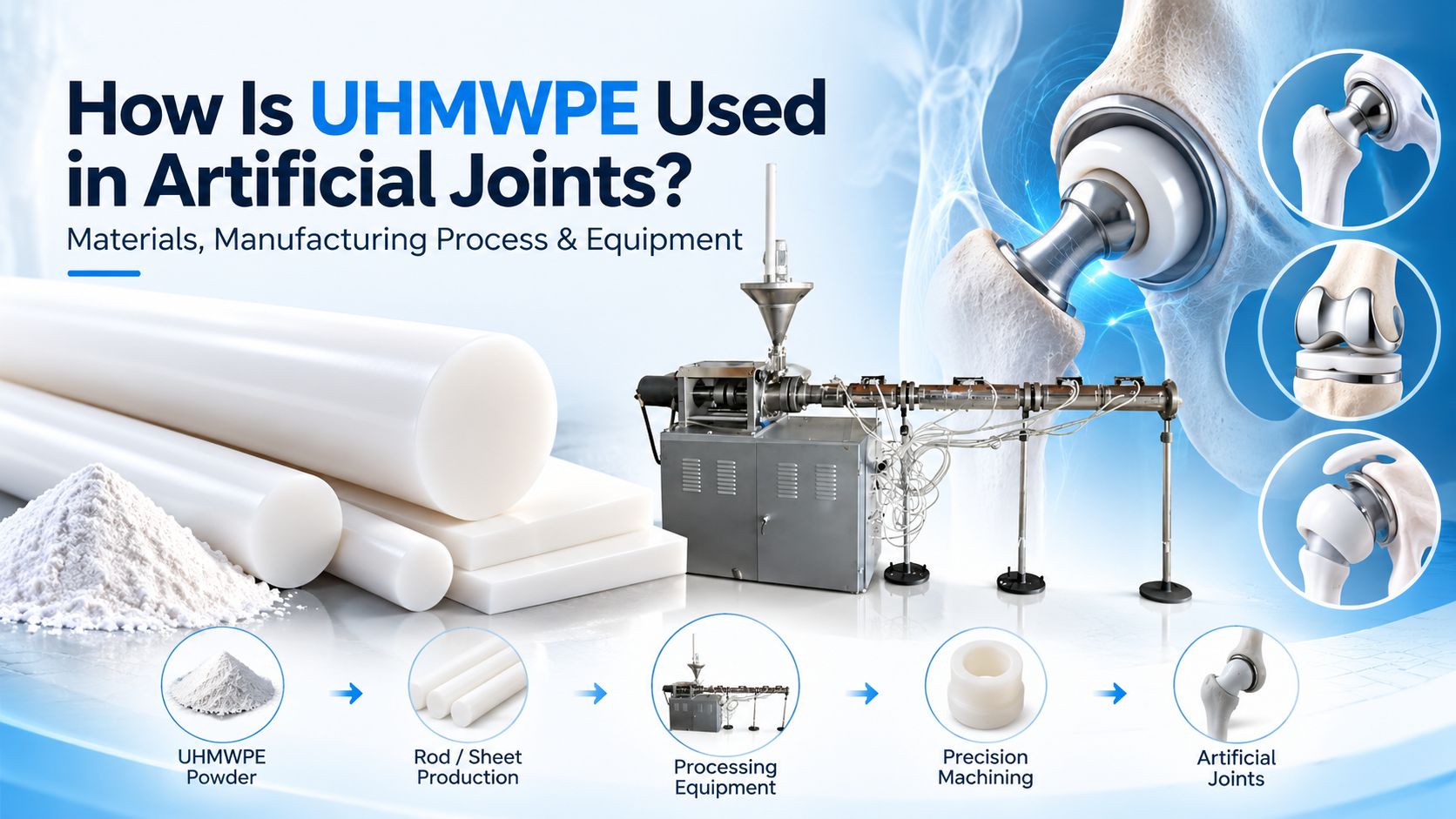
UHMWPE is generally supplied by specialized resin manufacturers in powder form. Because of its extremely high molecular weight and very high melt viscosity, it cannot be processed in the same way as many conventional thermoplastics.
Instead, UHMWPE powder is consolidated into solid material through specialized processes such as compression molding or ram extrusion.
A typical manufacturing route for orthopedic UHMWPE components may include:
UHMWPE powder selection → material consolidation → rod or sheet production → optional material treatments → precision machining → testing and final product validation.
The exact sequence depends on the material grade, component design, and manufacturing requirements. For example, crosslinking and thermal treatments may be incorporated into certain orthopedic material processing routes, but they are not universal steps for every UHMWPE product.
Once suitable semi-finished stock has been produced, manufacturers can machine it into the required component geometry. The final product must then meet the applicable material, performance, and regulatory requirements.
For companies planning to manufacture their own UHMWPE stock materials, choosing the appropriate forming process is one of the earliest and most important decisions.
UHMWPE Rod Extrusion vs. Compression Molding: Which Process Is Suitable?
Ram extrusion and compression molding are two established methods of consolidating UHMWPE powder into solid material. Both are used in the broader production of UHMWPE stock shapes, but their suitability depends on the intended product and manufacturing requirements.
UHMWPE Ram Extrusion
Ram extrusion is particularly relevant to the production of rods and certain continuous profiles. The process uses specialized equipment to consolidate and advance UHMWPE material through a forming system under controlled processing conditions.
For manufacturers producing rod stock for subsequent machining, ram extrusion can be an option worth evaluating. The target diameter, material grade, production capacity, and required material properties all influence equipment selection and process development.
UHMWPE Compression Molding
Compression molding is another established method for producing UHMWPE stock materials. It is commonly used to manufacture sheets and other molded forms, including stock that may subsequently undergo machining.
At SUKO, UHMWPE sheets are manufactured through hot compression molding, while our rod ram extrusion equipment is designed for rod production. These are different manufacturing routes, and selecting between them depends on the customer’s product requirements.
For orthopedic applications, neither process should be considered automatically superior in every situation. Material quality, processing conditions, testing results, and the requirements of the final component determine whether a particular manufacturing route is suitable.
What Equipment Is Needed to Produce UHMWPE Rods?
A UHMWPE rod production line requires more than a machine capable of producing the desired diameter. Manufacturers must consider material characteristics, tooling, temperature control, ram extrusion conditions, production capacity, and downstream handling.
SUKO independently develops and manufactures UHMWPE rod ram extrusion machinery, with equipment configurations covering rod diameters from 20 mm to 200 mm.
For a manufacturer establishing a new production line, the first step is to identify the intended rod specifications and material requirements. These details help determine the appropriate machine configuration, mold design, and processing approach.
Temperature management is particularly important because UHMWPE requires carefully controlled consolidation conditions. The ram extrusion process must also be matched to the material and tooling to support consistent production.
When different rod diameters or production requirements are involved, adjustments to molds, machine configurations, and operating parameters may be necessary.
SUKO’s experience in both polymer machinery development and UHMWPE material processing allows us to discuss these factors with customers from a practical manufacturing perspective.
Our related rod ram extrusion machinery can also be configured for PTFE rod production through appropriate tooling and processing adjustments, providing additional flexibility for manufacturers working with different high-performance polymers.
For more information about our equipment, explore the SUKO PFB80 PTFE/UHMWPE Rod Ram Extruder. This is one model within our broader machinery range, and equipment configurations can be discussed according to the required rod diameter and production capacity.
SUKO’s Experience in Customized UHMWPE Production Lines for Medical Manufacturers
Medical material manufacturers do not always have the same production requirements as conventional industrial rod suppliers.
Some customers need specific rod dimensions for downstream precision machining. Others may have particular raw material specifications, production capacity targets, or process control requirements that standard equipment configurations do not fully address.
SUKO has previously customized UHMWPE rod ram extrusion production lines for customers in the medical manufacturing industry.
During these projects, we worked with customers to evaluate their production requirements and made targeted modifications to our existing rod extrusion equipment.
Depending on the project, customized development can involve equipment configuration, structural adjustments, mold design, temperature control arrangements, and the optimization of ram extrusion parameters.
For example, when a customer’s target rod specifications differ from those supported by a standard configuration, the tooling and related equipment settings need to be evaluated together. When the selected raw material has different processing characteristics, the production parameters may also require adjustment.
These considerations are particularly relevant to medical material projects, where manufacturers often need to pay close attention to processing consistency, material documentation, and subsequent validation.
Our previous medical industry projects have given SUKO practical experience in discussing these requirements with customers and adapting machinery to their manufacturing objectives.
Rather than treating every UHMWPE production project as a standard machine sale, we aim to understand the intended material, product dimensions, and manufacturing process before recommending a suitable equipment solution.
From UHMWPE Rods and Sheets to Precision-Machined Components
Not every orthopedic manufacturer needs to operate its own UHMWPE rod extrusion line.
Some companies prefer to purchase semi-finished UHMWPE stock for machining, while others require custom components manufactured according to their drawings. Research and development projects may also need smaller quantities of material before production is scaled up.
SUKO supports these requirements through UHMWPE material supply and customized machining services.
We can provide UHMWPE rods in different specifications and discuss further processing according to customer drawings. We also manufacture UHMWPE sheets using hot compression molding, allowing customers to select a suitable stock form for their intended application.
For artificial joint-related projects, rod stock may be considered for certain machined components, while sheets or other molded forms may be more suitable for different geometries.
The choice depends on the final component design, material requirements, machining allowance, and applicable validation procedures.
This is where SUKO’s combination of material manufacturing and equipment engineering experience becomes useful. Our work with UHMWPE stock materials gives us practical insight into forming and machining considerations, while our machinery development capabilities help us understand how production equipment affects the manufacturing process.
Customers can therefore discuss either semi-finished material supply or their own UHMWPE rod manufacturing plans with the same team.
What Standards Apply to UHMWPE for Artificial Joint Manufacturing?
UHMWPE intended for surgical implant manufacturing is subject to specific material requirements that differ from those of general industrial polyethylene.
The ISO 5834 series is among the important standards used in this field.
ISO 5834-1 addresses UHMWPE powder molding materials used to manufacture forms intended for surgical implant production.
ISO 5834-2 addresses molded forms, including UHMWPE rods and sheets, intended for the manufacture of surgical implants.
ASTM F648 is another relevant specification for UHMWPE powder and fabricated forms used in surgical implant applications.
These material standards are important, but compliance with a material specification does not by itself establish that a finished artificial joint component is approved for implantation.
Depending on the product, manufacturers may also need to address quality management, biological evaluation, wear testing, sterilization, traceability, and other applicable regulatory requirements.
SUKO sources UHMWPE powder from professional raw material suppliers. For customer projects, we can help coordinate relevant supplier documentation and support discussions about material testing, technical records, and applicable validation requirements.
The suitability of any supplied material for an implant application must be confirmed through the appropriate material qualification and final product validation processes.
Should Manufacturers Buy UHMWPE Rods or Build Their Own Production Line?
This is a practical question for many companies entering or expanding their UHMWPE manufacturing activities.
Purchasing UHMWPE rods may be suitable for manufacturers that primarily focus on precision machining, require flexible material sourcing, or are still developing new products.
Establishing an in-house rod production line may be worth evaluating when a company has ongoing material requirements, specific rod dimensions, or a long-term plan to manage more of its manufacturing process internally.
However, operating a production line also involves equipment investment, process development, operator training, quality controls, and material testing. These factors should be assessed alongside production volume and business objectives.
SUKO can support both approaches.
For customers sourcing materials, we provide customized UHMWPE rods and related machining services based on agreed specifications.
For customers developing their own production capabilities, we offer UHMWPE rod ram extrusion machinery, mold development, equipment modifications, and process-related technical support.
Our previous experience customizing UHMWPE production lines for medical industry customers provides a practical foundation for these discussions.
UHMWPE Manufacturing Solutions for Artificial Joint Applications
UHMWPE continues to play an important role in artificial joint manufacturing, but successful production depends on much more than the polymer’s basic wear resistance.
Raw material selection, rod or sheet manufacturing, equipment configuration, precision machining, and final product validation must all be considered as part of the manufacturing process.
At SUKO, we combine UHMWPE material processing experience with independently developed rod ram extrusion machinery and customized production line capabilities.
Whether your company needs UHMWPE rods for orthopedic component development, precision-machined polymer parts, or equipment for establishing a dedicated UHMWPE rod production line, we can discuss solutions based on your actual manufacturing requirements.
Contact SUKO with your material specifications, rod dimensions, technical drawings, or production line requirements to explore a suitable UHMWPE manufacturing solution.
Website: https://www.sukoptfe.com/
Frequently Asked Questions
What is UHMWPE used for in artificial joints?
UHMWPE is used in bearing components such as hip acetabular liners, knee tibial inserts, and certain shoulder joint components. The material must be appropriately selected, processed, and validated for its intended medical application.
How are UHMWPE rods manufactured?
UHMWPE rods can be manufactured through specialized consolidation processes, including ram extrusion and compression molding. The appropriate process depends on material specifications, product dimensions, and manufacturing requirements.
Can UHMWPE be processed using a conventional plastic extruder?
UHMWPE has extremely high melt viscosity, making conventional melt extrusion unsuitable for many solid stock applications. Specialized methods such as ram extrusion and compression molding are commonly used.
What is the difference between UHMWPE rod extrusion and compression molding?
Ram extrusion is used to produce rods and certain continuous profiles, while compression molding is used for sheets and other molded forms. Both require suitable processing conditions and material controls.
Does SUKO manufacture UHMWPE rod extrusion machines?
Yes. SUKO independently develops and manufactures UHMWPE rod ram extrusion machinery, with configurations covering rod diameters from 20 mm to 200 mm. Customized molds and equipment modifications are available according to project requirements.
Has SUKO developed UHMWPE production lines for medical manufacturers?
Yes. SUKO has previously supplied customized UHMWPE rod ram extrusion production lines to customers in the medical manufacturing industry and provided equipment modifications and technical development support based on their requirements.
Can SUKO supply UHMWPE rods as well as production machinery?
Yes. SUKO provides UHMWPE rods, customized machining services, and rod ram extrusion equipment, allowing customers to discuss both material sourcing and in-house production requirements.
Contact
Phone/WhatsApp: +86 19975113419
E-mail:info@sukoptfe.com
contact: https://www.sukoptfe.com/contact/
Post time: Oct-21-2026