

PTFE tubes, rods, and hoses can look similar from the outside. However, they may be manufactured with completely different resin grades, equipment, and production processes.
PTFE does not flow freely like polyethylene or polypropylene after melting. Its melt viscosity remains extremely high. Therefore, standard screw extrusion and conventional injection molding are generally unsuitable for processing PTFE.
Depending on the required product, PTFE is usually processed by compression molding, granular ram extrusion, or fine-powder paste extrusion.
Understanding these three methods is important when selecting PTFE products or planning a PTFE production line.
Why PTFE Requires Special Processing
The melting point of PTFE is approximately 327°C. However, reaching the melting point does not turn PTFE into a freely flowing liquid.
Instead, PTFE retains extremely high melt viscosity. The resin particles must first be compacted into shape. They are then heated above the melting point so that the particle boundaries fuse during sintering.
A typical PTFE production route includes:
- Selecting the correct PTFE resin
- Preparing or mixing the resin
- Compacting or preforming the material
- Molding or extruding the required shape
- Removing lubricant when paste extrusion is used
- Sintering under a controlled temperature program
- Cooling, inspecting, cutting, or machining the product
The correct process depends on the resin grade, product shape, diameter, wall thickness, length, tolerance, flexibility, and production quantity.
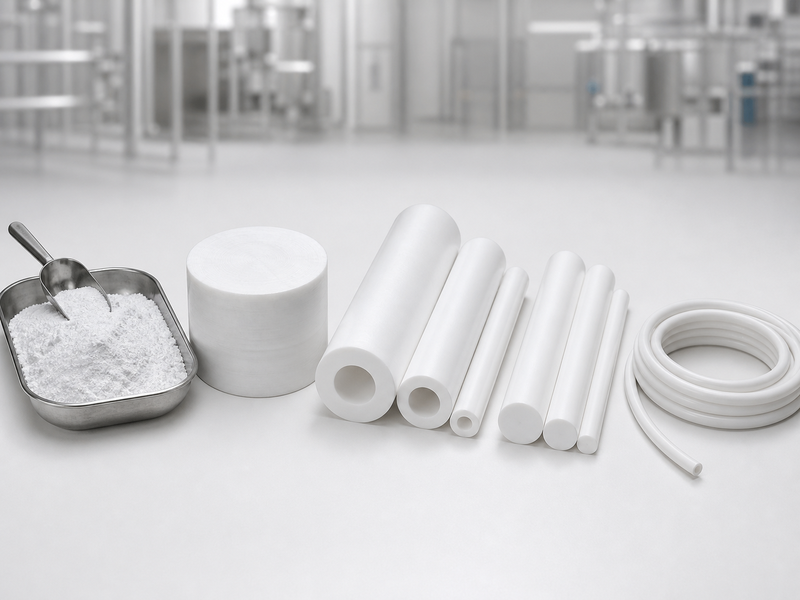
PTFE Resin Types and Their Processing Methods
Two main PTFE resin forms are used for tube, rod, and hose production.
Suspension-Grade Granular PTFE Resin
Granular PTFE resin is commonly used for compression molding and ram extrusion.
It is suitable for producing:
- Molded PTFE tubes and rods
- Large tube and rod billets
- Continuous ram-extruded tubes and rods
- Rings, bush blanks, and valve-seat blanks
- Sheets and machining stock
- Selected filled PTFE products
Virgin PTFE provides chemical resistance, electrical insulation, low friction, and general-purpose performance.
Glass fiber, carbon, graphite, bronze, and other fillers may be added to improve wear resistance, dimensional stability, thermal conductivity, or compressive performance. However, the selected compound must be compatible with the production process and equipment.
Dispersion-Grade Fine-Powder PTFE Resin
Fine-powder PTFE resin is mainly used for paste extrusion.
Before extrusion, the fine powder is carefully mixed with a processing lubricant. The material is then aged and compacted into a preform.
Paste extrusion is commonly used for:
- Flexible PTFE hose
- Industrial PTFE tubing
- Small-diameter PTFE tubes
- Thin-wall PTFE tubing
- Precision PTFE tubing
- Medical-grade PTFE tubing
- PTFE liners
- Wire and cable insulation
The lubricant reduces resistance between PTFE particles during extrusion. After extrusion, the lubricant must be removed under controlled conditions before the product is fully sintered.
Paste extrusion is not ordinary screw extrusion. It requires dedicated PTFE paste extrusion equipment, controlled resin preparation, appropriate die reduction, lubricant removal, and sintering.
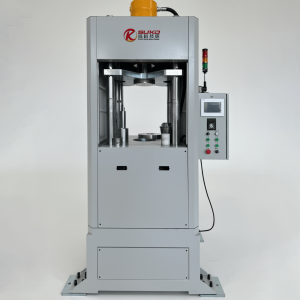
Compression-Molded PTFE Tubes and Rods
During compression molding, a measured amount of granular PTFE resin is placed inside a mold. When producing a tube, a central mandrel forms the inside diameter.
Pressure compacts the loose powder into an unsintered preform. The preform is then removed from the mold and transferred to a programmable PTFE sintering furnace.
Compression molding is suitable for:
- Large-diameter PTFE tube billets
- Thick-wall PTFE tubes
- Large PTFE rods
- Cylindrical machining billets
- Non-standard dimensions
- Bushings, sleeves, rings, and valve-seat blanks
- Components requiring further turning, drilling, or grooving
The product size can be changed by replacing the mold and mandrel.
Small and standardized products may use automatic molding equipment. Large-diameter, thick-wall, or high-powder-charge billets normally require semi-automatic heavy-duty molding presses.
A double-acting molding press applies pressure from both ends. This helps improve compaction uniformity through tall tube billets and bush blanks.
Granular PTFE Ram Extrusion
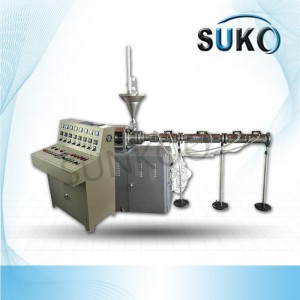
A PTFE ram extruder uses a reciprocating plunger to compact granular PTFE resin inside a barrel. Each pressing cycle pushes the previously compacted material forward.
The die controls the outside diameter. For PTFE tubes, a mandrel forms the inside diameter.
The compacted material passes through controlled heating zones, where the particles fuse and the profile is sintered.
Granular PTFE ram extrusion is commonly used for:
- Continuous PTFE rods
- Long PTFE tubes
- Standard round profiles
- Machining stock for seals and bushings
- Electrical insulating tubes and rods
- Repeated production of consistent sizes
Compared with compression molding, ram extrusion is generally more efficient for long products with a constant cross-section.
The resin flow characteristics, die, mandrel, feeding system, ram speed, heating zones, and temperature control must work together to maintain stable dimensions and internal quality.
Automatic powder feeding and cut-to-length systems can also be integrated into the production line.
PTFE Paste Extrusion for Hoses and Precision Tubing
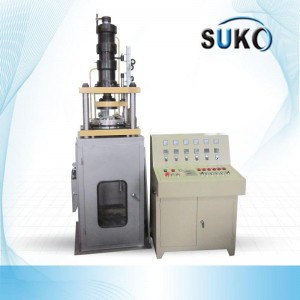
Paste extrusion is used when the product requires a smaller diameter, thinner wall, greater flexibility, or higher dimensional precision.
The process normally includes:
- Mixing PTFE fine powder with a processing lubricant
- Allowing the mixture to age under controlled conditions
- Forming the mixture into a cylindrical preform
- Loading the preform into the extrusion barrel
- Extruding the material through a die and mandrel
- Removing the processing lubricant
- Sintering or producing an unsintered product when required
- Cooling, measuring, cutting, or winding the tubing
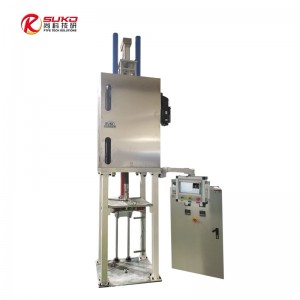
The extrusion die controls the outside diameter, while the mandrel controls the lumen or inside diameter.
Paste extrusion can produce industrial PTFE hose, transparent or translucent PTFE tubing, thin-wall tubing, liners, electrical insulation, and precision medical tubing.
Industrial hose lines normally focus on stable output, custom diameters, and continuous production. Precision tubing lines require more accurate control of the extrusion pressure, speed, OD, ID, wall thickness, concentricity, and take-up process.
For medical-grade tubing, production may also require cleanroom conditions, controlled handling, inspection records, and consistent batch management.
Comparing the Three PTFE Processes
| Comparison | Compression Molding | Ram Extrusion | Paste Extrusion |
|---|---|---|---|
| PTFE resin | Granular suspension resin | Granular suspension resin | Dispersion fine powder with lubricant |
| Main products | Large tubes, rods, billets, rings, and bush blanks | Long tubes, rods, and constant profiles | Hoses, thin-wall tubes, liners, and precision tubing |
| Production form | Individual preforms or billets | Continuous or repeated ram extrusion | Continuous extrusion followed by lubricant removal |
| Size adjustment | Change the mold and mandrel | Change the die and mandrel | Change the extrusion die, mandrel, and process settings |
| Sintering route | Normally uses a separate sintering furnace | Heating and sintering may be integrated into the line | Lubricant removal followed by controlled sintering |
| Main advantage | Flexible large and non-standard billet production | Efficient production of long standard profiles | Small, thin-wall, flexible, and precision tubing |
No single process is suitable for every PTFE product.
Compression molding is generally selected for large, thick-wall, short, or non-standard billets. Ram extrusion is suitable for long rods and tubes with a stable cross-section. Paste extrusion is used for PTFE hoses, small tubes, thin walls, liners, and precision tubing.
How Sintering Affects PTFE Quality
Sintering allows the compacted PTFE particles to fuse into a stable product.
The sintering cycle must consider the resin grade, product cross-section, production speed, furnace loading, and total material mass.
PTFE has low thermal conductivity. Therefore, a thick molded billet heats and cools differently from a thin paste-extruded tube.
For molded products, the furnace must provide controlled heating, holding, and cooling. For ram-extruded products, the heating zones and extrusion speed must remain coordinated. For paste-extruded tubing, the lubricant must first be removed without damaging the tube before sintering is completed.
An incorrect temperature program may result in insufficient fusion, deformation, discoloration, dimensional instability, or reduced mechanical performance.
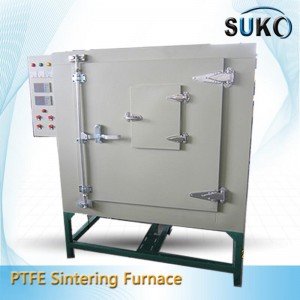
SUKO Products and PTFE Processing Equipment
SUKO manufactures PTFE products as well as PTFE processing machinery. This allows us to connect resin selection, product design, tooling, extrusion, molding, sintering, and final inspection.
Our product capabilities include:
- Compression-molded PTFE tubes and rods
- Large PTFE tube and rod billets
- Ram-extruded PTFE tubes and rods
- Industrial PTFE hoses
- Thin-wall and precision PTFE tubing
- PTFE liners and insulating tubes
- Custom-machined PTFE components
Our equipment range includes:
- Automatic and semi-automatic PTFE molding presses
- Double-acting PTFE bush molding presses
- PTFE tube and rod ram extrusion machines
- Industrial PTFE hose paste extrusion machines
- Precision PTFE medical tubing extrusion lines
- Resin mixing and preforming equipment
- Custom molds, dies, and mandrels
- Lubricant-removal and sintering systems
- Automatic feeding, cutting, and take-up equipment
Customers may purchase finished PTFE products, semi-finished billets, individual machines, or a complete production line.
Frequently Asked Questions
Why can PTFE not be processed with a standard screw extruder?
PTFE retains extremely high viscosity after melting and does not flow freely. It requires pressure-based processes such as compression molding, ram extrusion, or paste extrusion.
What is the difference between ram extrusion and paste extrusion?
Ram extrusion normally uses granular suspension-grade PTFE to produce rods and rigid tubes. Paste extrusion uses fine-powder PTFE mixed with lubricant to produce hoses, thin-wall tubes, liners, and precision tubing.
Which process is suitable for flexible PTFE hose?
Paste extrusion is generally used for flexible PTFE hoses and small or thin-wall tubing.
Which process is suitable for large PTFE tubes and rods?
Compression molding is normally preferred for large diameters, thick walls, short billets, and non-standard dimensions.
Which process is suitable for long PTFE rods and rigid tubes?
Granular PTFE ram extrusion is generally more efficient for long products with a constant cross-section.
Can the same PTFE machine produce several product sizes?
Yes, within the machine’s designed capacity. Product sizes can be changed by replacing the mold, die, or mandrel. The pressure, temperature, extrusion speed, and feeding settings must also be adjusted.
Can SUKO supply both the PTFE product and its production equipment?
Yes. SUKO supplies PTFE tubes, rods, hoses, machining billets, molding presses, ram extruders, paste extrusion lines, tooling, feeding systems, and sintering equipment.
Discuss Your PTFE Project
SUKO can support PTFE product development, resin and process selection, machine configuration, tooling design, sample production, and complete production-line planning.
Phone / WhatsApp: +86 19975113419
Email: info@sukoptfe.com
Post time: Aug-17-2026