

Fluoropolymer components used in aggressive chemical environments, semiconductor fabrication, and medical device manufacturing must undergo precise thermal processing to achieve the crystalline structure that gives PTFE its legendary chemical resistance and thermal stability. Without controlled sintering, as-molded PTFE parts retain irregular polymer chains that produce unpredictable mechanical properties, dimensional variance, and premature failure under service loads. Suko designs and manufactures industrial-grade sintering furnaces that give manufacturers the thermal precision their demanding applications require.
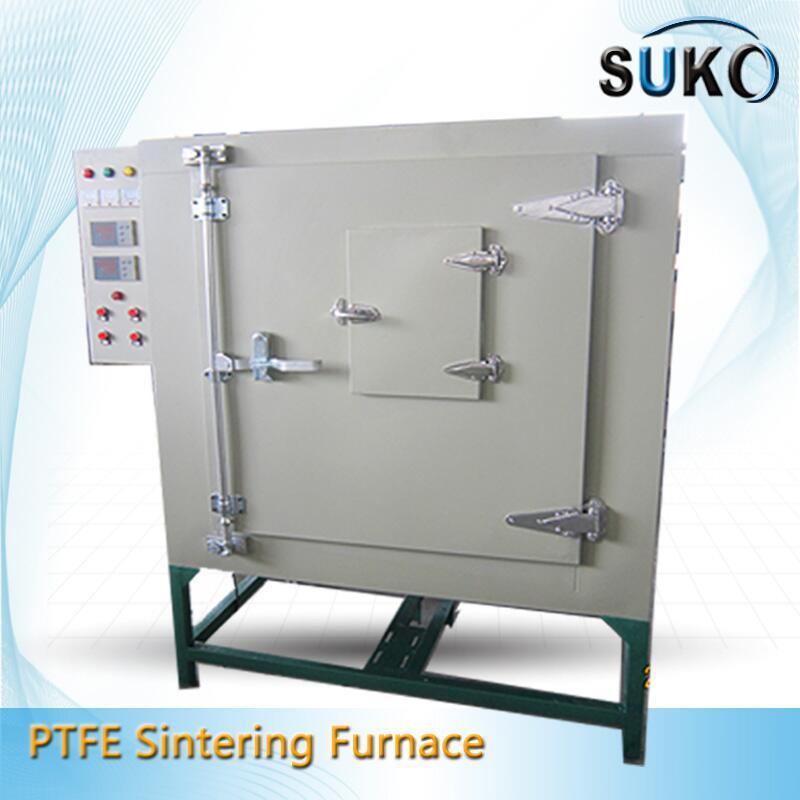
Our sintering furnace reaches working temperatures of 400°C continuously and brief excursions to 500°C, with molybdenum disilicide (MoSi₂) heating elements that provide stable, long-life high-temperature output. A 30-step programmable controller with PID automatic regulation maintains temperature accuracy to ±1°C throughout the sintering profile, ensuring that every part in a production run receives identical thermal treatment. This level of process control is what distinguishes Suko equipment in high-value manufacturing environments where scrap rates and rework costs directly impact production economics.
Why Thermal Uniformity Determines the Quality of Sintered Fluoropolymer Components
PTFE sintering is not simply heating a part to high temperature—it is a carefully engineered thermal profile that governs how polymer crystallites form and arrange during both the heating and controlled cooling phases. When a PTFE part enters a sintering furnace, the material passes through its crystalline melt transition, allowing molecular chains to reorganize into consistent lamellar structures. The rate of heating, the duration at peak temperature, and the cooling ramp all influence the final degree of crystallization, which directly controls hardness, flexural modulus, chemical resistance, and dimensional stability.
Non-uniform temperature distribution within the furnace chamber produces thermal gradients that cause internal stress concentrations, warping, and property variation between parts loaded in different furnace zones. Suko addresses this challenge through careful furnace geometry design and multi-zone temperature monitoring. The result is a consistently even thermal field across the full chamber volume, so parts loaded at the door or at the back of the chamber receive the same thermal exposure. Manufacturers report significantly reduced scrap rates and more predictable finished-part properties after switching to Suko sintering equipment.
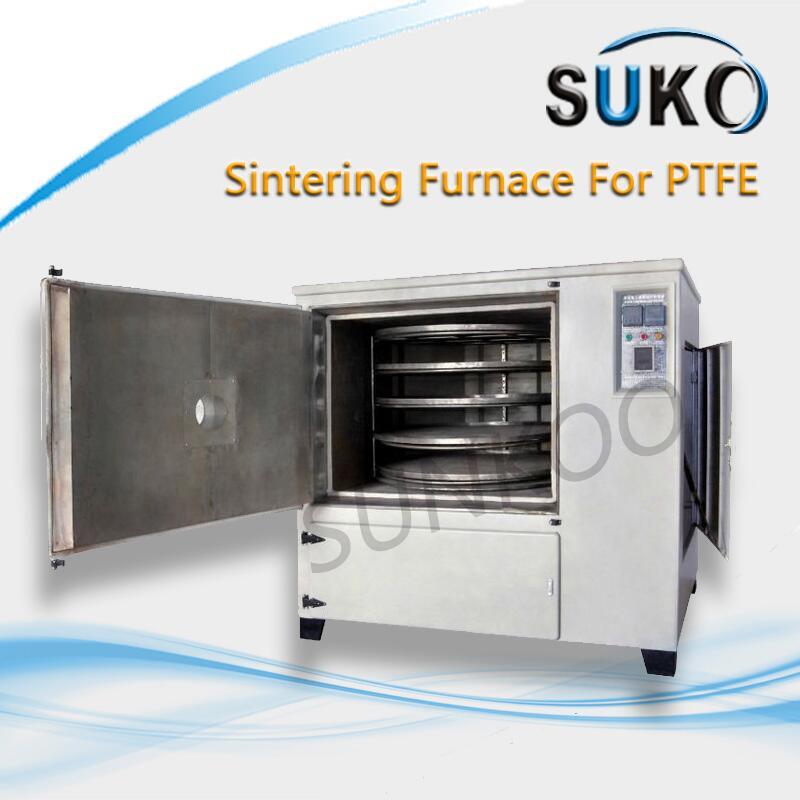
Technical Specifications: Engineered for Demanding Fluoropolymer Processing
The Suko sintering furnace is available in standard and custom-configured chamber sizes to match specific production batch requirements:
| Chamber Size | 150 x 150 x 150 mm (6″x6″x6″) |
| Working Temperature | 400°C ( continuous ) |
| Maximum Temperature | 500°C |
| Temperature Control | 30 steps programmable and PID automatic control |
| Heating Rate | 0~15°C/min (suggestion: ≤10°C) |
| Temperature Accuracy | +/-1°C |
| Heating Element | Molybdenum Disilicide (MoSi2) |
| Working Voltage | AC 220V, Single Phase, 60/50 Hz (or according to your requirement) |
| Max. Power | 24 KW |
| Outside Size | 500 x 485 x 700mm |
| Wooden box size | 600 x 585 x 900mm |
| Net Weight | 95 Kg |
| Gross Weight | 120 Kg |
Industries Served: From Chemical Processing to Semiconductor and Medical Device Manufacturing
Fluoropolymer sintering is foundational to multiple high-precision manufacturing sectors. Chemical processing plants use sintered PTFE components—liners, gaskets, valve seats, and pump impellers—in processes involving concentrated acids, organic solvents, and thermal cycling. The chemical resistance and wide service temperature range of properly sintered PTFE make it irreplaceable in these harsh-service applications.
In semiconductor fabrication, ultra-high purity sintered PTFE components are essential for wafer handling, chemical distribution, and etch process equipment. The sintering furnace used in these applications must produce parts with minimal extractable ionic contamination and surfaces free from organic residues. Suko furnaces deliver the thermal profiles required for semiconductor-grade PTFE processing, with documentation supporting purity verification testing.
Medical device manufacturers rely on sintered PTFE for implants and surgical instruments that must pass biocompatibility testing under ISO 10993 requirements. The sintering process parameters directly influence surface finish, mechanical strength, and biostability—properties that are critical for devices that remain in contact with human tissue for extended periods.
Customer Success Stories: Global Deployment and Repeat Orders
Suko sintering furnaces have been shipped to manufacturers across Europe, Asia, and the Americas. A recent installation in Ireland involved a PTFE Sintering Furnace exported for use in an advanced polymer components production facility. The customer reported consistent output quality from the very first production cycle, with full documentation and installation support provided by the Suko technical team.
In a particularly noteworthy case, a Belgian engineering team evaluated multiple sintering furnace suppliers before standardizing on Suko equipment. After comprehensive factory audits and hands-on process demonstrations, the customer placed an order for six sintering furnaces—a decision that reflected rigorous technical due diligence and full confidence in Suko manufacturing capability and product quality. The customer visit to our production facility included detailed review of our quality management system, thermal testing procedures, and component traceability protocols.
In South Africa, a leading industrial manufacturer deployed a Suko sintering furnace for processing custom PTFE components used in mining and chemical processing equipment. The furnace was configured with high insulating property to ensure temperature uniformity within the hearth, while the fixed time-value and temperature-value sintering profile delivered highly repeatable results across successive batches. This reliability in demanding operating conditions is what drives repeat orders from manufacturers worldwide.
Suko sintering furnace vs. competing solutions
When evaluating industrial sintering equipment, procurement teams consistently identify several key differentiators that favor Suko:
- · Molybdenum disilicide heating elements rated for continuous 400°C operation and 500°C peak—suitable for PTFE, PFA, PEEK, and specialty fluoropolymer grades
- · 30-step programmable PID controller with ±1°C temperature accuracy across the full chamber working volume
- · Flexible power configuration: standard 220V single-phase or custom three-phase for global deployment
- · Compact design (500 × 485 × 700 mm) for straightforward facility integration and standard international shipping crates
- · Full compliance documentation package including test reports, operation manuals, and maintenance procedures
- · Process validation trials available using customer-supplied materials before equipment commitment
- · Spare parts and technical support available through Suko global distributor network
Maintenance and Service: Keeping Your Sintering Furnace at Peak Performance
Industrial sintering furnaces require periodic maintenance to preserve thermal performance and extend service life. Suko provides comprehensive maintenance documentation covering heating element inspection and replacement, thermocouple calibration procedures, insulation integrity checks, and controller firmware updates. Our technical support team responds to service inquiries within one business day, and critical spare components are available with standard international shipping.
For facilities operating multiple Suko furnace models, we offer preventive maintenance contracts that include annual thermal profiling, calibration certification, and priority parts fulfillment. These contracts are particularly popular among medical device and semiconductor manufacturers who must maintain production qualification records as part of their quality management system compliance.
Frequently Asked Questions
What maximum temperature does the Suko sintering furnace reach? The furnace operates continuously at 400°C and can reach brief excursion temperatures of 500°C. For optimal material properties in standard PTFE sintering, Suko recommends a heating rate not exceeding 10°C per minute.
What fluoropolymer materials can be processed in this furnace? The furnace is designed for PTFE, PFA, FEP, PEEK, and related high-performance polymers. The MoSi₂ heating system provides the thermal output and longevity required for processing these engineering-grade materials.
Can the furnace process parts of non-standard dimensions? Yes. The standard chamber configuration is 150 × 150 × 150 mm, but Suko manufactures custom chamber sizes and shelf configurations to accommodate larger parts or higher batch volumes.
Is the furnace suitable for pharmaceutical and medical device manufacturing environments? Yes. Suko sintering furnaces are used by manufacturers serving pharmaceutical and medical device markets. Process documentation supports quality system compliance including ISO 13485 and FDA 21 CFR Part 820 requirements.
What power supply does the furnace require? Standard configuration is AC 220V, single-phase, 60/50 Hz. Custom voltage configurations including three-phase options are available for industrial facilities in global markets.
How long does it take to receive a sintering furnace after ordering? Standard models ship within four to six weeks of order confirmation. Custom-configured furnaces typically require eight to twelve weeks. International deliveries include wooden crating for transport protection and full customs documentation.
Conclusion: Your Partner in Precision Thermal Processing
Choosing a sintering furnace is a long-term capital investment that shapes product quality, production throughput, and manufacturing cost structure for years to come. Suko brings deep expertise in high-temperature thermal processing of fluoropolymers, combining rigorous engineering standards with responsive customer support to deliver equipment that performs reliably across thousands of operating hours.
Our global service network provides process optimization consulting, preventive maintenance programs, and technical support backed by decades of accumulated application knowledge. Whether you are established in chemical processing, semiconductor manufacturing, medical devices, or aerospace, Suko has the thermal processing solutions your manufacturing operation needs.
Contact our engineering team today to discuss your thermal processing requirements, request a process validation trial, or receive a detailed equipment specification package. Let Suko show you the difference that precision thermal engineering makes in fluoropolymer component manufacturing.
Related Equipment from Suko
PTFE Corrugated Pipe Machine for fluid handling systems
PTFE Rod Extruder for continuous rod and tube production
PTFE Hydraulic Molding Press for complex part geometries
PTFE Sintering Furnace product page and full specifications
PTFE Corrugated Pipe Machine at SuKo Machinery (cross-site reference)
Post time: May-27-2026