
Choosing a Corrugated Pipe Machine: Look at What It Can Consistently Produce, Not What the Spec Sheet Says
Most corrugated pipe machine spec sheets look the same. Diameter range. Wall thickness. Pressure rating. The numbers line up.
But a spec sheet won’t tell you whether the machine holds wall thickness tolerance after 1,000 continuous meters. It won’t tell you whether it can switch from PTFE to PEEK without a full retool. And it certainly won’t tell you whether the manufacturer has production data to back up any of its claims.
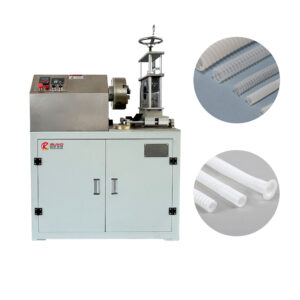
The difference between a machine that prints a good brochure and a machine that runs stable production is what happens before it reaches your factory floor. This page explains what that difference looks like — in documented production data, not marketing language.
What This Machine Can Do
The machine produces corrugated pipe from DN1/2 to 32 inch (10 mm to 800 mm), with wall thickness from 0.18 to 2.0 mm. It supports single or double SS304 braid reinforcement, delivers finished pipe rated to 10 MPa working pressure, and operates across a temperature range of -196°C to +700°C. Connections can be flanged, threaded, or welded. The machine complies with ANSI, JIS, DIN, and GOST standards.
| Parameter | Specification |
| Pipe Diameter Range | DN1/2 – 32 inch (10 mm – 800 mm) |
| Wall Thickness Capability | 0.18 – 2.0 mm |
| Braid Layer | Single or double SS304 |
| Max Working Pressure | 10 MPa |
| Operating Temperature | (-196) ~ (+700) °C |
| Connection Type | Flange / Threaded / Welded |
| Standards | ANSI, JIS, DIN, GOST |
Those are the machine’s capabilities on paper. What matters more is what it produces consistently. This machine has been validated across two high-performance materials: PTFE and PEEK.
Material 1: PTFE Corrugated Pipe
The machine produces smooth-bore corrugated PTFE pipe — flat inner wall, corrugated outer wall — across a diameter range of DN10 to DN32.
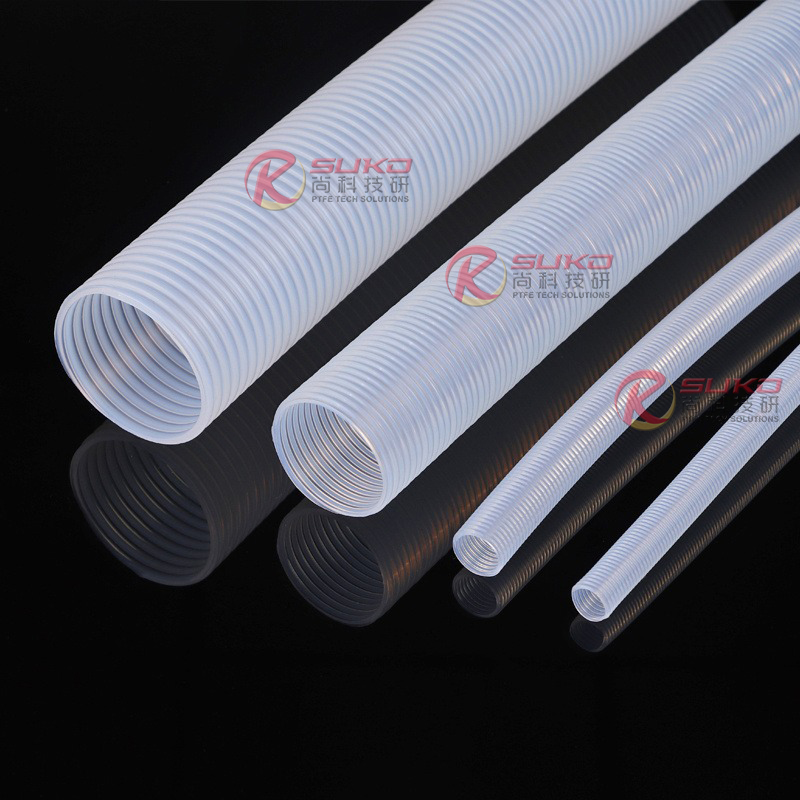
Typical production sizes: 3/8″ (10 mm), 1/2″ (13 mm), 5/8″ (16 mm), 3/4″ (19 mm), 1″ (25.4 mm), 1-1/4″ (32 mm).
These pipes go into food processing lines that require FDA compliance and repeated steam sterilization. Into pharmaceutical solvent transfer where chemical inertness and zero extractables are non-negotiable. Into chemical plants moving strong acids and alkalis. Into automotive fuel and coolant systems where temperature cycling is constant. The machine holds the tolerances these applications demand.
Material 2: PEEK Corrugated Pipe
The same machine produces corrugated PEEK pipe from 3/16″ (4.76 mm) to 1″ (25.4 mm).
Typical production sizes: 3/16″, 1/4″, 3/8″, 1/2″, 5/8″, 3/4″, 7/8″, 1″.
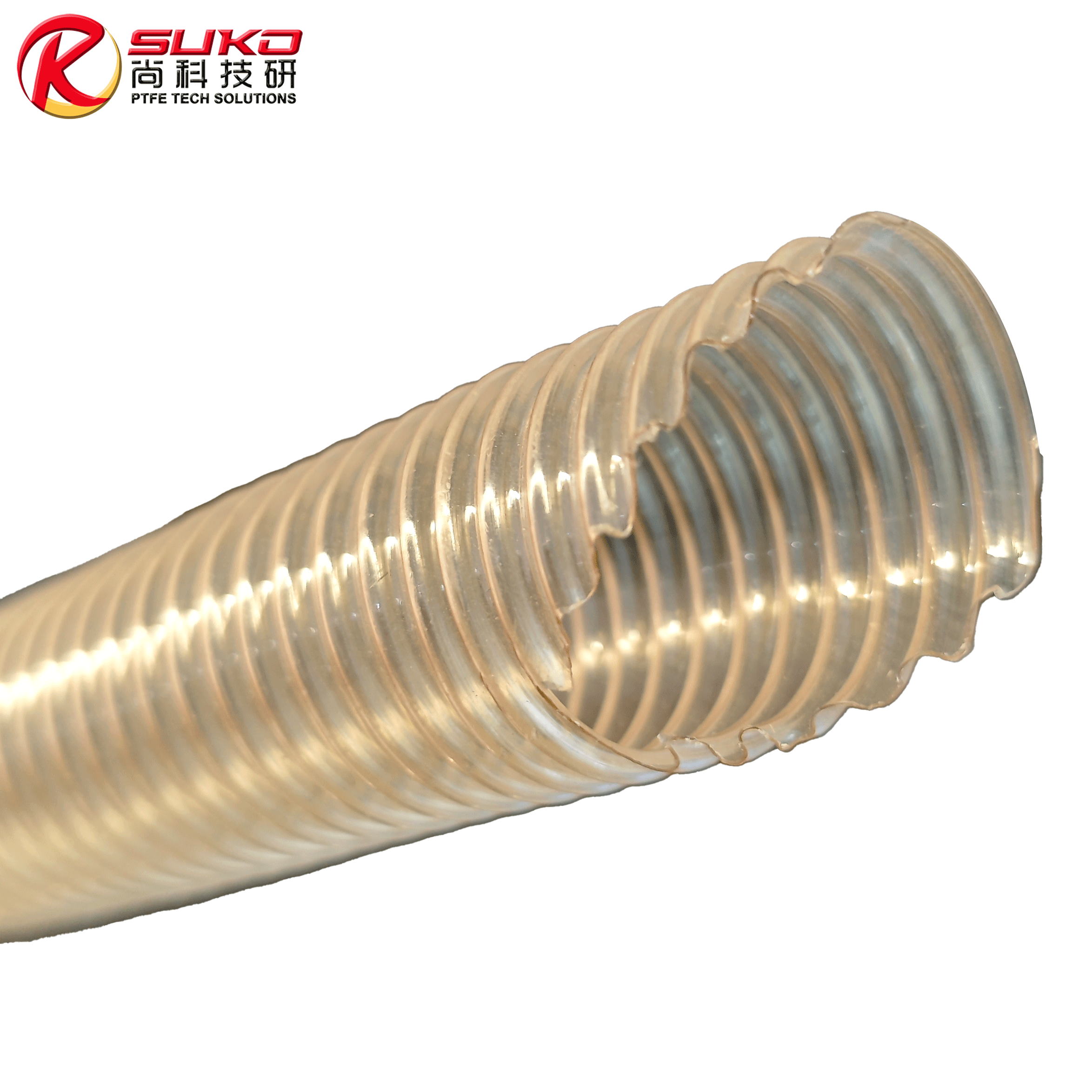
PEEK pipe goes into hotter, more abrasive environments. Automotive engine compartments, where continuous 260°C and instantaneous 300°C+ are routine. High-temperature chemical processing where hot concentrated acids are flowing under pressure. Industrial wire harness protection where abrasion resistance and mechanical toughness matter more than chemical resistance.
Why One Machine Can Handle Both Materials
PTFE and PEEK are not interchangeable on a standard extrusion line. They make very different demands on the equipment.
PTFE has high melt viscosity and flows differently from conventional thermoplastics. The machine’s forming die geometry — specifically the flow channel design — must account for this. Get the die wrong, and wall thickness wanders.
PEEK melts at roughly 120°C higher than PTFE. The machine’s heating zones and temperature control system must hold a tighter band at a higher setpoint. A cold spot anywhere in the system means inconsistent forming.
To run both materials on the same machine without rebuilding it for each switch, three things have to be right:
Forming die cavity geometry. The die must be designed for a viscosity range wide enough to accommodate both material behaviors. This isn’t an off-the-shelf die. It’s machined in-house based on material-specific flow data accumulated over years of production runs.
Hydraulic pressure curve mapping. PTFE and PEEK respond differently to pre-compression, hold, and release phases during corrugation. The machine’s hydraulic system must allow precise adjustment of each phase. If the pressure curve isn’t tunable by material, one of the two will produce thin spots or incomplete corrugation.
Temperature uniformity across the heating zone. At PEEK processing temperatures, any deviation across the barrel or die creates inconsistency. The sintering oven or heating section must maintain uniformity within a narrow band. This is a function of heater placement, insulation design, and control loop tuning — all of which we build and calibrate in-house.
This isn’t about having a “universal” machine. It’s about having a machine whose core systems — die, hydraulics, heating — are engineered and built under one roof, with process data from both materials feeding back into the design.
Production Verification: What This Machine Has Actually Produced
A machine’s real capability is measured by what it has already produced under test conditions, with both sides watching.
Korea: 5 Diameters, One FAT, ±0.03 mm
A chemical pipe manufacturer in South Korea ordered this machine and set a clear acceptance condition: five diameters must pass Factory Acceptance Testing before the machine ships.
The FAT covered DN4, DN8, DN12, DN16, and DN20. Each diameter was run under continuous production conditions at our Changzhou facility. Wall thickness deviation was measured and recorded at each size. The result: ±0.03 mm across all five diameters.
Engineers from both companies measured together. Both sides signed every page of the FAT report. The machine was installed and in full production within two weeks of arrival.
Japan: On-Site Material Testing Before Signing
A Japanese client flew to Changzhou to evaluate production equipment before committing. They brought their own PTFE resin — not to test our material, but to test whether the machine could produce their target specifications using their actual raw material input.
The test ran across three diameters: DN6, DN10, and DN15. Diameter tolerance came in at ±0.05 mm or better. Wall thickness uniformity and surface quality were measured against the client’s internal specification sheet. All parameters passed.
They signed the contract on the spot. The same on-site testing protocol applies to our corrugated pipe machine — bring your material, set your target specs, and we’ll run it while you measure.
Singapore: Repeat Orders as a Stability Signal
A Singapore-based manufacturer purchased a PTFE rod extrusion line with auxiliary sintering equipment. After two years of production, they returned to order additional lines for capacity expansion.
Their original acceptance records are on file. When a manufacturer buys again, the machine has already proven itself on their factory floor, under their production schedule, with their operators.
How to Verify Machine Quality Before You Buy
If you’re evaluating a corrugated pipe machine, here are four ways to check whether the manufacturer’s claims hold up.
1. Bring Your Own Raw Material and Run It
Don’t watch a demo with the manufacturer’s material. Bring yours. If the machine can’t produce consistent wall thickness and surface finish with your resin, it won’t do it after it’s installed either. The Japanese client’s approach — test first, sign after — is the right one. We follow the same protocol for corrugated pipe machine evaluations.
2. Ask to See the Process Database
A machine that ships with pre-loaded process parameters — temperature curves, pressure maps, extrusion speeds — starts from a different point than a blank machine with a manual. Ask what process data comes with the machine. If the answer is vague, the commissioning will be long.
3. Review Previous FAT Records
Factory Acceptance Test records from previous deliveries show what the machine has actually achieved under test. Look for: number of diameters tested, whether continuous production was run or just spot samples, and whether both sides signed. The Korean client’s FAT — five diameters, ±0.03 mm, dual sign-off — is the level of documentation to expect.
4. Ask About Spare Parts Supply — Specifically
Ask the manufacturer which parts are made in-house and which are outsourced. Ask for the longest period a client has waited for a critical spare part. If the manufacturer buys key components from third parties, your spare parts supply chain runs through someone else’s factory. Know that before you sign.
Why We Build Dies, Hydraulics, and Sintering Ovens In-House
SUKO was founded in 2006. Our equipment operates in over 40 countries, including Japan, South Korea, Germany, and the United States.
We machine our own forming dies. We build our own hydraulic systems. We design and calibrate our own sintering ovens. These are the three systems that determine whether a corrugated pipe machine produces consistent output or drifts.
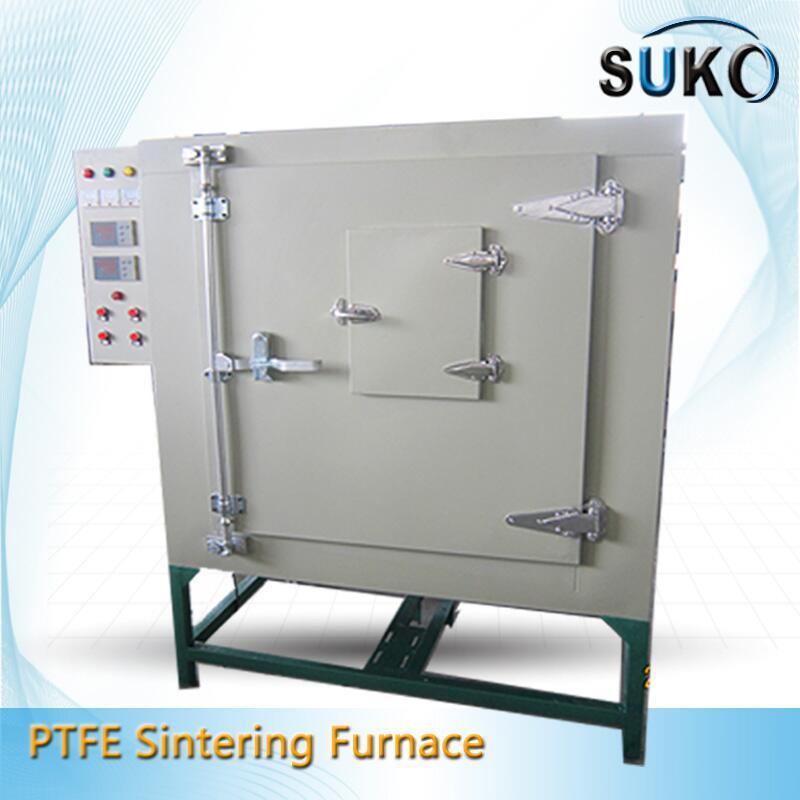
When these are built under one roof, process parameters match. When a quality deviation occurs, we trace it and fix it — without calling three different suppliers to figure out who’s responsible. In nearly two decades, no client’s production has stopped because of a part we couldn’t supply.
The factory is in Changzhou. It operates daily. You can visit without notice. What you see is what you get.
6 Questions to Ask Before Buying a Corrugated Pipe Machine
1. What’s the difference between this machine and others with similar-looking spec sheets?
The spec sheet tells you the machine’s theoretical range. It doesn’t tell you whether the machine holds tolerance across that entire range under continuous production, or whether it can switch between materials like PTFE and PEEK without extensive retooling. Ask for FAT records that show multi-diameter, continuous-run data — not just maximum and minimum values.
2. Can I test the machine with my own raw material before signing?
Yes. Bring your PTFE or PEEK resin to Changzhou. We’ll run your material on the machine and measure diameter tolerance, wall thickness uniformity, and surface quality together. This is the same testing protocol our Japanese client followed before signing — applied directly to the corrugated pipe machine.
3. What wall thickness tolerance can the machine actually hold?
±0.03 mm, documented during a FAT across five diameters (DN4 through DN20) for a Korean chemical client. Both sides measured. Both sides signed. This is a recorded production result, not a theoretical capability.
4. How long from installation to stable production?
The machine ships with pre-configured process parameters based on production data from your target material. On-site work is fine-tuning, not trial and error. Installation, commissioning, and operator training are completed within an agreed schedule. A blank machine takes weeks longer — that’s not what we ship.
5. How do you handle spare parts supply over the long term?
Core parts — forming dies, hydraulic valve assemblies, heating elements — are built in-house or sourced from long-term stable suppliers. In nearly two decades, no client has had a machine idled by a part we couldn’t deliver. Core spare parts inventory is maintained for up to 10 years.
6. What diameters and materials can the machine cover?
DN1/2 to 32 inch (10 mm to 800 mm) in diameter. Wall thickness from 0.18 to 2.0 mm. PTFE and PEEK, with separate process parameter sets for each. Single or double SS304 braid reinforcement. Flanged, threaded, or welded connections. ANSI, JIS, DIN, and GOST standards. Customization available for requirements outside these ranges.
Our Factory Runs Every Day. Bring Your Material. Test the Machine.
Our Changzhou facility doesn’t do showroom displays. The machines are in production. The FAT records are on file. The process database is real — accumulated over nearly two decades of production runs, not compiled from manuals.
If you’re evaluating a PTFE corrugated pipe machine, bring your raw material. We’ll set up the diameter and wall thickness you care about. You watch the measurements come in. You decide.
Post time: Jun-06-2026