
You just commissioned a PTFE paste extrusion line. The supplier’s technician spent three days on your factory floor, dialed in a set of parameters for your first product, shook your hand, and left. The machine is running. You’re making tube.
Then you get an order for a new specification — different OD, thinner wall, tighter tolerance. Your operator stares at the control panel. The parameters the technician left behind were for the last product. There’s no reference table, no deviation guide, no logic tree. The machine is in your factory. The process know-how just walked out the door.
This is the unspoken reality of PTFE paste extrusion: the capital equipment is the easy part. The process intelligence is the bottleneck. And in most cases, that intelligence still lives in the supplier’s pocket — not in your engineering file.
For a manufacturer that has been building PTFE paste extrusion lines for over 17 years, with installations across more than 40 countries, every scenario above is not hypothetical. It’s a service call we’ve taken. SUKO’s approach to paste extrusion systems is built on a different premise: the machine and the process knowledge ship together, in documented, repeatable, trainable form.
1. The “Flying-In Technician” Model Is a Knowledge Transfer Failure
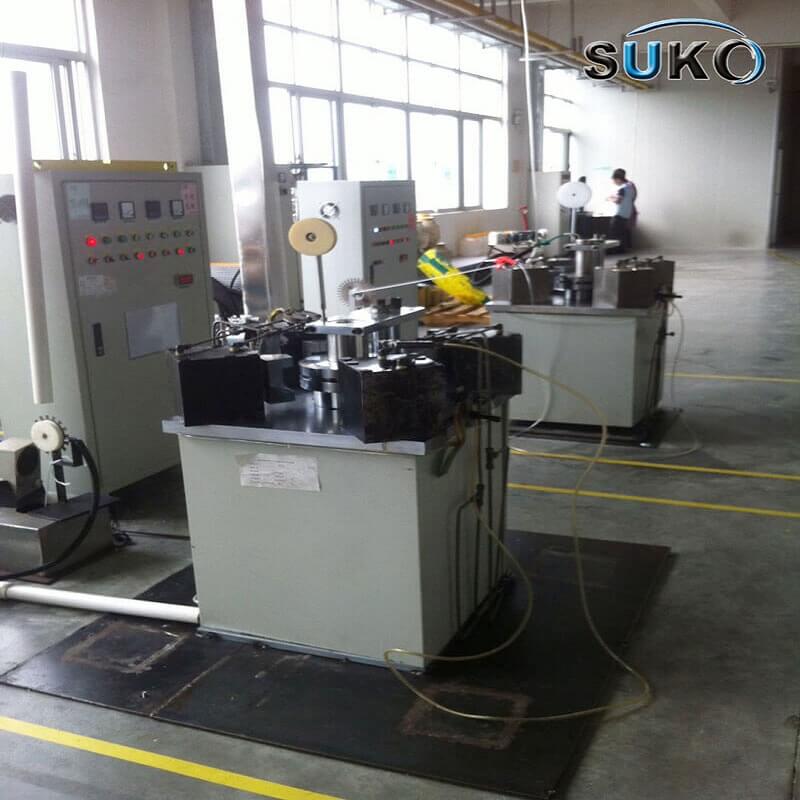
The standard commissioning model in this industry looks like this: the equipment arrives, a technician flies in for 3–5 days, sets up one product recipe, runs a few acceptance samples, and leaves. You get a machine. You don’t get a process manual.
Three months later, you introduce a new product. The raw material is a different PTFE fine powder grade. The wall thickness target is tighter. Suddenly, the “proven” parameters don’t translate. Your team has no framework for parameter adjustment — no understanding of the relationship between reduction ratio, paste viscosity, ram speed, and die pressure. They can’t troubleshoot because they were never trained on principles. They were trained on one recipe.
A paste extruder without documented process knowledge isn’t a production asset. It’s a dependency.
The equipment supplier’s responsibility should extend beyond the iron. At minimum, you should receive: a parameter matrix covering the interaction effects of extrusion speed, die temperature, and preform pressure; a solvent ratio adjustment guide for different PTFE powder grades; and a troubleshooting decision tree for common defects like surface cracking, ovality, and wall thickness drift. If your supplier can’t provide these, you didn’t buy a production line. You bought a hardware kit and a prayer.
2. Nameplate Capacity Says 98 m/h. What Does Your Factory Floor Say?
Every paste extrusion line comes with a nameplate capacity. It’s always an impressive number. It’s also almost always measured under laboratory conditions: standard reference material, brand-new tooling, climate-controlled environment, one dedicated operator.
Your factory floor is not a laboratory. Your raw material has batch-to-batch variation in particle size distribution and moisture content. Your die has accumulated 2,000 hours of wear. Your factory ambient temperature swings 8°C between morning and afternoon. Add these real-world variables together, and that nameplate 98 m/h becomes 70 m/h — if you’re lucky and disciplined.
Now you face the dilemma every production managers knows: slow down to maintain precision, or push speed and risk quality?
The difference between a capable paste extrusion line and an exceptional one is not the theoretical maximum speed. It’s the speed at which the line can run while holding your tightest tolerance. Some lines achieve 98 m/h but can only hold ±0.08mm wall tolerance at 60 m/h. The question to ask your supplier isn’t “What’s the maximum speed?” It’s “What’s the maximum speed at ±0.03mm wall tolerance, using three different powder grades, after 1,000 hours of tooling life?” If they pause before answering, you have your answer.
SUKO PTFE paste extrusion lines are engineered for production-floor reality, not laboratory brochures. Our systems cover 0.5mm–60mm OD range, with documented speed-tolerance curves across multiple PTFE fine powder grades, so you can plan production schedules against actual capability — not wishful thinking.
3. ±0.03mm Wall Tolerance: A Promise Is Not a Process
Tight wall thickness tolerance on PTFE tubing doesn’t come from the extruder alone. It’s the cumulative output of an entire line: preform consistency, solvent ratio uniformity, ram pressure stability, die temperature profile, puller speed synchronization, and cooling rate. One variable drifts, and the entire tolerance stack collapses.
Many equipment suppliers sell you a machine and write “±0.03mm tolerance” in the specification sheet. But when you ask how that tolerance is achieved, validated, and maintained, the conversation gets quiet.
Here’s what a genuine tolerance commitment should include: a documented process window study showing the parameter ranges within which the tolerance holds; an on-site capability study (Cpk/Ppk) run on your production floor with your operators and your raw material; and a tolerance maintenance schedule that defines tooling replacement intervals, sensor recalibration frequency, and critical process variable monitoring points.
The ugly truth is that most paste extruder suppliers sell the host machine, not the turnkey process. They deliver a motor, a gearbox, a ram, and a die — and leave the process integration to you. Tolerance on paper is marketing. Tolerance in production is engineering. Demand the engineering.
4. The Hidden Cost of Changeover: When Flexibility Becomes a Liability
A paste extrusion line that covers 0.5mm–60mm diameter range sounds like the ultimate flexible asset. And it can be — if changeover is fast, documented, and predictable. In practice, for many lines, switching from one product specification to another means: die disassembly and cleaning, parameter recalibration, preform adjustment, trial extrusion, measurement, further adjustment, and final sign-off. Total downtime: 2–4 hours. Sometimes more.
For a factory running large batches of standard sizes, this is manageable. For a factory serving diverse, low-volume, multi-SKU orders, the math is brutal. Two changeovers per day at 3 hours each is 6 hours of downtime. That’s 25% of your available capacity, gone — not to maintenance, not to breakdowns, but to switching between paying jobs.
Changeover time is not a footnote in the spec sheet. It’s a direct deduction from your annual output.
When evaluating a paste extrusion line, ask for a documented changeover procedure with time benchmarks. Ask whether quick-change die systems are available. Ask how parameter presets are stored, recalled, and adjusted between product specifications. A machine that requires artisan-level skill to change over is a machine that scales poorly. A machine with recipe management, modular tooling, and documented setup sequences scales with your business.
5. The Sintering Furnace Black Box: Where Your PTFE Tube Is Born or Broken
The sintering stage is where PTFE transforms from a dried extrudate into a finished engineering material. This is not a drying step. It’s a phase transformation. The temperature must rise through the melting point of PTFE (approximately 327°C) and continue to 380°C–500°C, held precisely, then cooled at a controlled rate. Get the temperature curve wrong, and the tube is brittle. Get the cooling rate wrong, and internal stress is locked into the polymer matrix, waiting to cause dimensional instability or cracking downstream.
Yet, across the domestic PTFE equipment market, the sintering furnace remains a data black box. Most suppliers do not provide real-time temperature profile recording as standard. The furnace has a setpoint display. The actual temperature distribution across zones, the dwell time consistency, the cooling rate — these remain invisible. When a batch problem emerges, there’s no data trace to determine whether the root cause was a temperature excursion during sintering or something upstream. You rely on the “experienced operator” who “knows how the furnace behaves.” That’s not process control. That’s oral tradition.
A sintering furnace without data logging is a quality system gap waiting to become a customer complaint.
Modern PTFE paste extrusion lines should include multi-zone temperature monitoring with automated data recording, real-time curve display, deviation alarms, and batch-level traceability reports. This data should be exportable for your quality management system — because when your medical-device customer asks for sintering process evidence, “the operator said it looked fine” is not an acceptable answer.
SUKO has been building PTFE paste extrusion lines for over 17 years, with installations across more than 40 countries. Every scenario described above is not hypothetical — it is a service call we have taken and resolved. Our paste extrusion systems are engineered on a different premise: the machine and the process knowledge ship together, in documented, repeatable, trainable form.
Closing the Loop: From Black Box to Transparent Process
The difference between a standard PTFE extrusion supplier and a true engineering partner isn’t measured in output per hour. It’s measured in whether your team can independently operate the line six months after commissioning. That’s why every SUKO line ships not just with a manual, but with a structured parameter matrix, changeover procedure logs, and sintering furnace data that integrates into your existing QMS.
About SUKO PTFE
SUKO (www.sukoptfe.com) is a specialist manufacturer of PTFE paste extrusion systems, based in China with over 17 years of engineering heritage. Our product range covers complete paste extrusion lines for PTFE tubing, rod, sheet, and profiles — including paste extruders, drying tunnels, sintering furnaces, and downstream handling equipment. We supply turnkey systems with documented process parameters, on-site Cpk capability studies, and full sintering furnace data logging as standard. Our equipment is installed and running in PTFE processing facilities across more than 40 countries. We understand that you’re not buying a machine — you’re buying a production capability. Our job is to make sure that capability stays in your hands, not ours.
Post time: May-29-2026